
SMPL
Mumbai (Maharashtra) [India], December 19: India’s fintech looks cutting-edge – but could a small ₹3,000 machine on a dusty counter be its biggest blind spot! On one side, India is facing an identity-fraud wave. Deepfake-related cybercrime cases have surged by over 550% since 2019, with losses projected to reach about ₹70,000 crore in 2024.
On the other side, we are still importing a majority of our electronic components and devices from outside India. In 2023-24, electronics, telecom and electrical imports were dominated by China and Hong Kong – together accounting for a large chunk of our components and finished devices. While China currently dominates India’s electronics and component imports, the deeper issue isn’t the country itself — it’s our systemic dependence on opaque, foreign-controlled hardware for high-trust financial flows.
Put those two curves together – exploding identity fraud and heavy reliance on low-cost imported hardware – and a hard question appears:
Can India really build a trusted fintech ecosystem on top of devices it doesn’t fully control?
Crucially, this is not only a “China problem”. Today it may be China; tomorrow it could be any other market willing to flood India with cheap, opaque devices. If our answer is simply to keep switching the country of origin – without fixing how and where the hardware is designed, secured and manufactured – we will keep recreating the same vulnerability with a different flag.
Policymakers are already signalling their discomfort. India has excluded Chinese vendors from new 5G deals, asked operators to disclose where high-risk equipment sits in their networks, and tightened rules on CCTV and other connected hardware citing national-security and surveillance risks. The direction of travel is clear: critical infrastructure cannot run on black-box devices whose design, firmware and data paths we cannot audit on our own soil.
Yet in fintech, we still routinely plug the cheapest available terminals and peripherals into the highest-trust use cases – Aadhaar-linked withdrawals, subsidy disbursals, micro-ATM cash-outs, agent-assisted KYC, locker access, even the soundboxes and printers that sit at the edge of the transaction journey. In doing so, we quietly outsource our identity perimeter to the lowest bidder in the global supply chain.
This is where the debate around “ID or imposter?” stops being philosophical and becomes brutally operational.
Identity in fintech is no longer just a screen in the journey; it is critical infrastructure. And infrastructure cannot be a dumping ground for end-of-life electronics, insecure modules and uncertified peripherals.
Strategically, India’s fintech stack now has to answer three questions at the same time:
1. Can we verify that the person is real – not a deepfake, synthetic ID or replayed biometric
2. Can we trust the device doing that verification – its sensor, firmware, keys and data pathway – including the so-called “peripherals”: fingerprint scanners, face-auth cameras, POS terminals, printers, soundboxes and routers at the edge?
3. Can we, as a country, live with the geopolitical and supply-chain risk if we get the answer to (1) and (2) wrong at scale?
That is why the next decade belongs to identity-first, device-led fintech – built on hardware that is certified, secure, locally accountable and aligned with Indian policy, not just procurement budgets.
Practically, that means:
* Moving from single-factor to multimodal identity (face + fingerprint + liveness + cryptographic device ID).
* Using sensors that detect heat, depth and micro-movement – not just match a static image.
* Ensuring biometric data is encrypted at capture and stays tamper-proof in transit, inside trusted execution environments.
* Extending the same discipline to every peripheral in the transaction chain – terminals, scanners, printers, soundboxes – because each one is now an attack surface.
* Choosing OEM partners whose design, manufacturing and key management are transparent, auditable and rooted in India – not just assembled here, but truly “Designed, Secured and Made in India”.
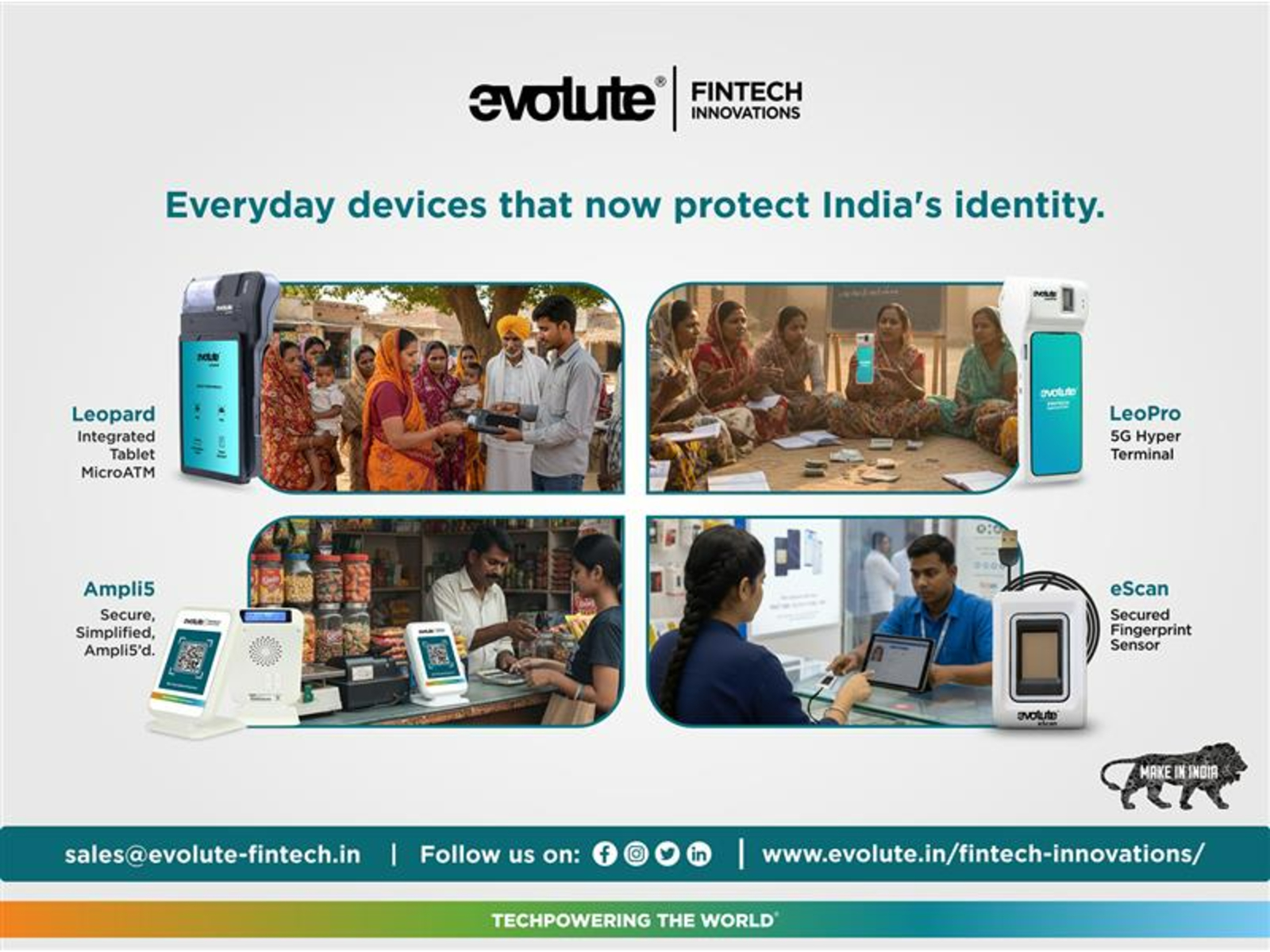
This is the lens through which players like Evolute Fintech Innovations are building India’s next-generation identity devices and terminals: treating every LeoPro, Leopard, eScan, soundbox or face-auth module as a trust anchor in the financial system, not a commodity gadget. The goal is not just import substitution; it is to create a domestic identity hardware stack where regulators, banks and citizens know where the silicon comes from, how the firmware is signed, and where the keys live.
Because ultimately, the competitive question in fintech is shifting.
It’s no longer “Who has the slickest app?” or “Who has the lowest MDR?”
It’s: “Whose stack – from sensor to cloud, including every peripheral on the counter – can the regulator, the bank and the citizen actually trust?”
That is also where policy on dumping, imports and digital sovereignty quietly intersects with fintech strategy. If identity is the new perimeter, then devices are the new borders. Leaving those borders to the lowest bidder is not a business choice; it is a systemic risk.
If there is one takeaway for leaders in banking, fintech and policy, it is this: stop optimising for the cheapest device and start optimising for the hardest-to-fake identity – built on secure, Made-in-India hardware that you can audit, question and improve.
Evolute Fintech Innovations is firmly on the side of the latter.
If you’re serious about making your identity stack your strongest asset – not your biggest blind spot – it’s time to re-think the hardware under your fintech. Start that conversation with us at ceo@evolute.in
For more information, please visit: https://www.evolute.in/fintech-innovations/
(ADVERTORIAL DISCLAIMER: The above press release has been provided by SMPL. ANI will not be responsible in any way for the content of the same.)
Disclaimer: This story is auto-generated from a syndicated feed of ANI; only the image & headline may have been reworked by News Services Division of World News Network Inc Ltd and Palghar News and Pune News and World News

HINDI, MARATHI, GUJARATI, TAMIL, TELUGU, BENGALI, KANNADA, ORIYA, PUNJABI, URDU, MALAYALAM
For more details and packages